Castle Cats - Idle Hero RPG
- 4.7
- Rating
- 5.00M
- Installs
- Free
- Price

 Analysis by App-foxy
I spent time with Castle Cats - Idle Hero RPG as a lighthearted adventure game built around collecting heroes and letting your team keep moving while you are away. Its cat-themed presentation is immediately approachable, but the real question is whether the idle format gives you enough to do when you are actively playing. My answer is mostly yes, provided you enjoy gradual progress, roster building, and short check-in sessions more than constant action.
The game comes from PocApp Studios and is free to start. That distinction matters here: you can enter without paying, while optional in-app purchases range from $0.99 to $99.99 per item. I found the free access useful for understanding the core loop before deciding whether spending would improve my experience. It is also rated for Everyone, so its cheerful tone and straightforward fantasy setting make it an easy recommendation for younger players and casual adults alike, with the usual reminder that optional purchases should be controlled on a shared device.
How the idle adventure feels in everyday play
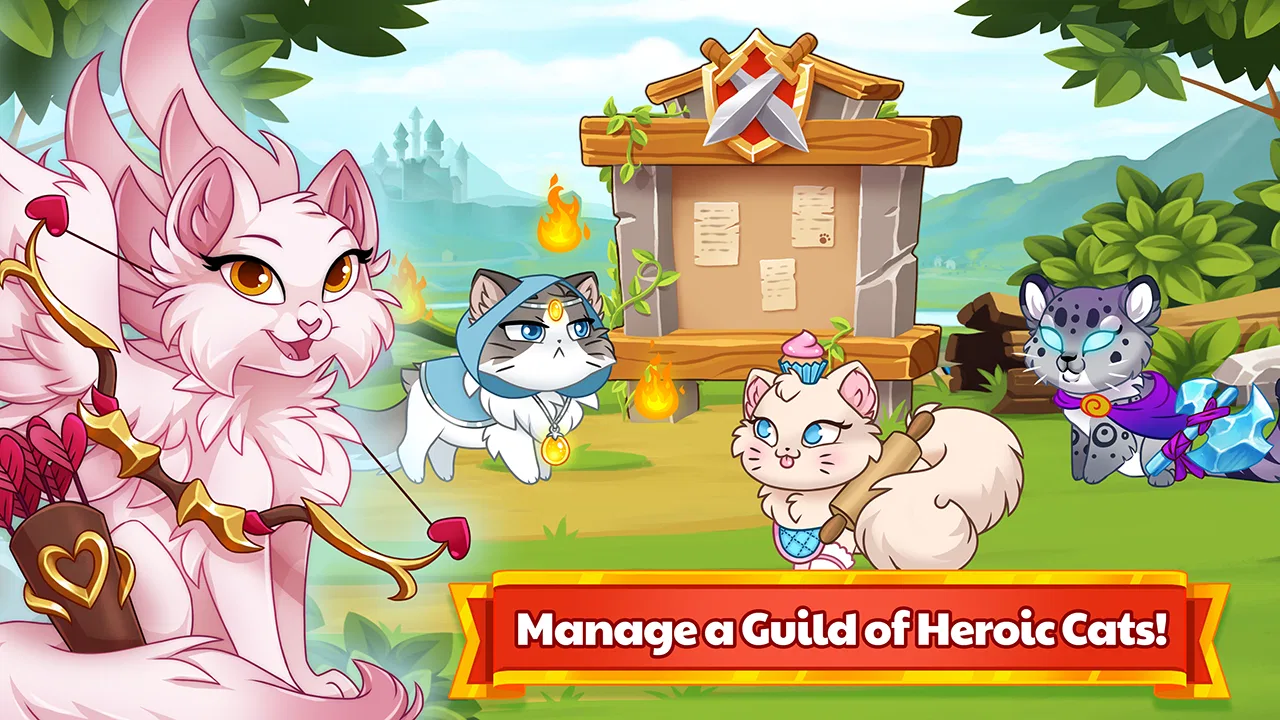
The basic appeal is simple. You gather a group of cat heroes, send them into adventures, collect the results, and use those results to strengthen the team. The game is designed around returning regularly rather than sitting through one long session. I could open it during a spare moment, deal with completed activities, make a few roster decisions, and close it without feeling that I had abandoned a complicated quest.
You May Also Like

 Blood Strike: 2.5 Anniversary
Blood Strike’s Loadouts Turn Every Drop Into a Tactical Gamble
A close look at Blood Strike’s custom loadouts: how fast access to signature weapons reshapes its battle royale rhythm, rewards preparation, and narrows the gap between fights.

 Pandora - Music & Podcasts
Pandora’s Music Is Easy to Start, but Harder to Recover
Pandora’s strength is its low-effort path from a seed to a station. Its weak spot is how much confidence it asks you to place in connection, setup, and quiet recovery.

 8 Ball Pool
 Is Built on Rivalries, Rematches, and Routine
A close look at the rivalries, rematches, shared routines, and unanswered safety questions that turn a quick pool match into a persistent mobile community.

 Samsung Music
’s Quiet Strength Is Playing What You Already Own
Its reach comes less from spectacle than from dependable access to a personal library. That simplicity is both the app’s strongest retention engine and its ceiling.

 AccuWeather: Weather Radar
AccuWeather Review: A Quick, Clear Forecast for Everyday Decisions
For everyday plans, the best forecast is the one you can understand quickly. AccuWeather makes rain timing, radar, and local conditions easy to act on, with a few trade-offs.

 Hill Climb Racing
Why Hill Climb Racing Still Turns Crashes Into One More Run
A tiny car, a bumpy hill and one more upgrade: Hill Climb Racing keeps resurfacing because its simple chaos makes every near-miss feel personal.
More From Our News Desk



That makes it a good companion for a routine such as commuting, waiting for an appointment, or taking a short break from work. A practical session might begin with collecting accumulated rewards, checking which hero needs attention, and choosing the next activity before putting the phone away. The point is not to finish a whole campaign in one sitting. The satisfaction comes from making a small improvement now and seeing that choice matter when I return later.
The adventure category is expressed through the setting and the sense of sending a team into trouble, but this is not an action game in the usual sense. You are not relying on quick reflexes, precise movement, or a controller-like combat system. The important decisions are about which heroes to develop, how to assemble a useful group, and when to spend the resources that have accumulated. Players expecting a fast, hands-on battle experience should adjust their expectations before installing it.
What kept me interested was the collection layer. A new hero is not merely another character to place on a screen; it gives me a reason to rethink the team I have been using. That creates a gentle form of experimentation. I could keep a dependable group for routine progress, then test a different combination when I wanted to see whether a less familiar lineup worked better.
The cat theme also helps the game avoid feeling overly serious. The presentation is playful rather than grim, which suits the idle structure. I never felt that I needed to memorize a dense fantasy history before enjoying the game. That accessibility is one of its strongest qualities, especially for someone who wants a friendly mobile RPG rather than a demanding second job.
What I would do during the first few sessions
I would resist the temptation to treat every reward as something that must be spent immediately. Early progress is more useful when I first understand the rhythm of the game: collect, improve, send the team back out, and return later. That small pause makes it easier to notice which upgrades genuinely help my preferred heroes and which purchases or improvements are simply attractive in the moment.
I would also avoid building a roster around only the first characters I like visually. The collection is most interesting when I compare practical usefulness with personal preference. A favorite hero can remain part of the team, but I found that leaving a little room for experimentation made the progression feel less automatic. This is one of the less obvious strengths of an idle RPG: because the game handles much of the waiting, the decisions I make between waits become more noticeable.
Another useful habit is to treat active play and idle progress as two different modes. When I only have a minute, I can handle the essential tasks and leave. When I have more time, I can inspect the roster and think about longer-term development. Trying to force every session into a complete optimization exercise makes a relaxed game feel unnecessarily demanding.
How the free model affects the experience
The verified cost structure is straightforward: the game is free to download and play, with optional purchases priced from $0.99 to $99.99 per item. I see that as a reason to test the game rather than dismiss it immediately. Free access lets a player decide whether the idle loop is enjoyable before paying anything, which is especially important because this style of game depends heavily on personal tolerance for waiting and repeated check-ins.
At the same time, “free” does not mean that every player will experience the same value. Someone who enjoys slow, earned progression may be perfectly happy spending nothing. Someone who wants to accelerate collection or reduce the patience required by the idle structure may feel more pressure to consider purchases. I would make that decision only after playing long enough to know whether I like the underlying routine, not because a limited-time opportunity or a tempting upgrade appears on the screen.
The broad purchase range also means the game can fit very different spending habits, but it requires self-control. A small optional purchase and a much larger one do not represent the same value, even though both are presented within the same free-to-start environment. I would set a personal limit before buying anything, particularly if a child is playing on a device connected to a family payment method.
For me, the best value is available when I treat purchases as optional convenience rather than an entrance fee. If the free progression already gives me enough reasons to return, the game has done its job without asking for money. If I dislike waiting, no purchase can change the fact that the central design is still an idle RPG. Paying may alter the pace, but it does not turn the game into a different genre.
Where the game delivers real value
Its strongest value is flexibility. I do not need a large uninterrupted block of time, and I do not have to be highly skilled at action combat. The game rewards regular attention in small amounts, which makes it suitable for players who want something to check throughout the day. That is a more specific benefit than simply calling it casual: the design works best when it becomes a brief routine rather than the main activity on the phone.
The hero-collection structure adds a second layer of value. Building a roster gives progression a personal feel, because I am not only raising one character along a fixed path. I am deciding which cats deserve attention and which team arrangement I want to try next. That choice is modest compared with the complexity of a full strategy RPG, but it is enough to keep the game from becoming a completely passive reward screen.
I also appreciate that the game can be played in two moods. If I am tired, I can perform the basic maintenance and leave. If I am curious, I can spend more time comparing heroes and planning the next improvement. Many mobile games are either too shallow when played briefly or too demanding when played casually; this one sits more comfortably between those extremes.
Its audience size supports that appeal. The game has passed five million installs, with an average rating of 4.7 from around 189 thousand ratings and roughly 16 thousand written reviews. Those figures do not guarantee that every player will enjoy the idle format, but they do suggest that the combination of approachable art, collection, and low-pressure progression has found a substantial audience.
The tradeoffs I noticed
The main limitation is the waiting itself. Idle progress is convenient, but it can also make the game feel slow if I want immediate control over the outcome. There are moments when I would rather make a direct tactical move than simply prepare a team and wait for the result. This is not a flaw in execution so much as the central tradeoff of the design. The game is rewarding when I enjoy anticipation and disappointing when I want constant interaction.
Repetition is another consideration. The loop of collecting rewards, improving heroes, and sending them out again is comfortable, but its comfort can become predictability. I would not recommend it to someone who needs a new mechanic or a dramatic challenge every few minutes. The collection decisions provide variety, yet they do not remove the repeated structure underneath.
The free-to-start economy can also affect how I judge progress. Even without spending, I may become aware that optional purchases exist and wonder whether I am advancing at the intended pace. That feeling is manageable when I focus on the game as a relaxed hobby, but it can become distracting for players who compare their progress with an imagined ideal. The healthiest approach is to decide whether the current pace is enjoyable on its own.
There is also a difference between liking the theme and liking the mechanics. The cat characters make the game inviting, but a charming presentation cannot compensate for a dislike of idle progression. I would not install it solely because the setting looks cute. The deciding factor should be whether collecting and gradually improving a team sounds satisfying.
The technical baseline is relatively accessible: the current version is 4.4.20.13.17 and it supports devices running Android 7.1 or later. That makes it relevant to people using older compatible Android hardware, although the experience will still depend on the individual phone. I would keep enough storage and battery headroom for any mobile game, but I would not choose this title expecting the visual or mechanical demands of a modern console-style RPG.
Who will get the most from it
I think the best match is a player who enjoys collecting characters but does not want to manage a complicated game every time they pick up the phone. It suits people who like seeing a team grow over days of short visits, and it is particularly comfortable for anyone who prefers planning over reflexes. The Everyone rating also makes it a friendly choice for families, although adults should still supervise optional purchases when appropriate.
It is a good fit for a secondary game. I could keep it alongside a more demanding adventure title and use it when I wanted something calmer. The two experiences serve different purposes: a traditional action RPG asks for focus and direct input, while this game gives me progress that can be checked around the edges of the day. That contrast is where it makes the most sense.
I would be more cautious about recommending it to competitive players who need precise rankings, intense real-time battles, or a strong sense of mechanical mastery. I would also steer away players who dislike free-to-play economies on principle, even when purchases are optional, because the presence of a broad purchase range may remain irritating. A premium game with a single upfront price would be a better fit for someone who wants to remove that concern completely.
It may also disappoint anyone looking for a story-heavy adventure with long dialogue scenes and carefully directed exploration. The appeal here is the team and its gradual development, not the feeling of personally controlling every step of a cinematic journey. Understanding that distinction before downloading will prevent most of the disappointment I can imagine.
My practical recommendation before spending
I would begin by playing it entirely free and observing three things: whether I enjoy returning for short sessions, whether the hero-collection choices feel meaningful, and whether the natural pace is satisfying without acceleration. Those answers are more useful than judging the game from its theme or from a single exciting reward. If all three are positive, the free version already offers a worthwhile mobile pastime.
If I later considered an in-app purchase, I would connect it to a clear personal goal rather than buying because the game is free. For example, I might decide that a small convenience is worth it only if I am still playing consistently and understand what it changes. I would not jump from a low-cost item to a much larger one simply because the larger option appears to promise faster progress. The listed range, from $0.99 to $99.99 per item, makes that boundary especially important.
I would also remember that idle games are easiest to enjoy when they remain proportionate to the rest of the day. Checking in briefly is useful; feeling obligated to return constantly is not. If the routine starts to feel like a chore, taking a break is a better response than spending to recover the excitement. The game should fit my schedule, not dictate it.
Final verdict for Android players
Castle Cats - Idle Hero RPG is a pleasant free adventure game for players who enjoy collecting heroes, making light team decisions, and watching progress accumulate between short visits. PocApp Studios has built its appeal around accessibility and a playful cat setting, but the real reason to stay is the combination of roster building and low-pressure idle advancement.
My recommendation is positive with a clear condition: choose it for relaxed collection and gradual progress, not for hands-on action. The free entry point gives it a fair chance to prove itself, while the optional purchases mean I would keep spending strictly voluntary and controlled. If you enjoy a game that can turn a few spare minutes into a small daily adventure, it is worth trying. If you want direct combat, a fixed premium price, or constant novelty, I would skip it in favor of a more traditional RPG.
For my own use, its best role is the easygoing game I can open without preparing for a major session. I can check the castle, make a team decision, and leave with the feeling that the next visit will have something waiting. That is not a substitute for a deep action adventure, but within its idle niche, it delivers a friendly and accessible way to build a growing group of heroes.
FAQs for Castle Cats - Idle Hero RPG
01What is Castle Cats - Idle Hero RPG?
Castle Cats - Idle Hero RPG is a casual role-playing and collection game where you build a team of heroic cats, send them on quests, and defend your kingdom from enemies. Its colorful presentation, humorous writing, and simple controls make it accessible to younger and casual players, while collecting heroes, upgrading abilities, and completing missions provide longer-term progression.
02How does the gameplay work in Castle Cats?
The main gameplay revolves around choosing cats for missions, allowing them to battle enemies, and collecting rewards such as coins, experience, equipment, and new heroes. Much of the combat is automated, so you do not need fast reflexes or complicated controls. However, selecting suitable team members, improving their statistics, and managing quest timing still gives the game a light strategic element.
03Can Castle Cats be played offline?
Castle Cats may allow some basic gameplay features to continue without a constant internet connection, but online access can be required for certain activities, advertisements, cloud synchronization, updates, events, and purchases. Offline behavior may also vary by device and game version. If you want uninterrupted access to every feature, it is best to launch the game while connected to the internet.
04Is Castle Cats free to download and play?
Castle Cats - Idle Hero RPG is generally free to download, but it includes optional in-app purchases and advertising. You can progress without spending money, although purchases may speed up upgrades, provide extra resources, or offer other conveniences. Players should review the store listing and configure parental or purchase protections, especially if children will be using the device.
05Is Castle Cats suitable for children and casual players?
The game is generally suitable for casual players because its cartoon art style, straightforward objectives, and automated battles are easy to understand. It does not demand long sessions or advanced gaming skills, making it convenient for short play periods. Nevertheless, parents should check the current age rating, advertising content, chat or social features, and in-app purchase settings before allowing children to play.
Pros
- Large roster of collectible cats with varied skills and roles.
- Idle rewards let you make progress even during short play sessions.
- Lighthearted art style and humorous character designs feel family-friendly.
- Regular events and quests provide extra goals beyond the main campaign.
- Simple controls make the game easy to learn on phones and tablets.
Cons
- Progress can feel slow without spending premium currency or waiting.
- Many upgrades and rewards rely on repeated grinding over time.
- Energy or similar limits may interrupt longer play sessions.
- The amount of menus and currencies can feel confusing at first.
- Online features and cloud progress may depend on a stable connection.

Castle Cats - Idle Hero RPG
Gallery